


What Is Nose Tape and How Does It Work?
What nose tape is, how it works and how to choose one, from the studies and from the people who wear it. Prices checked 10 November 2026.
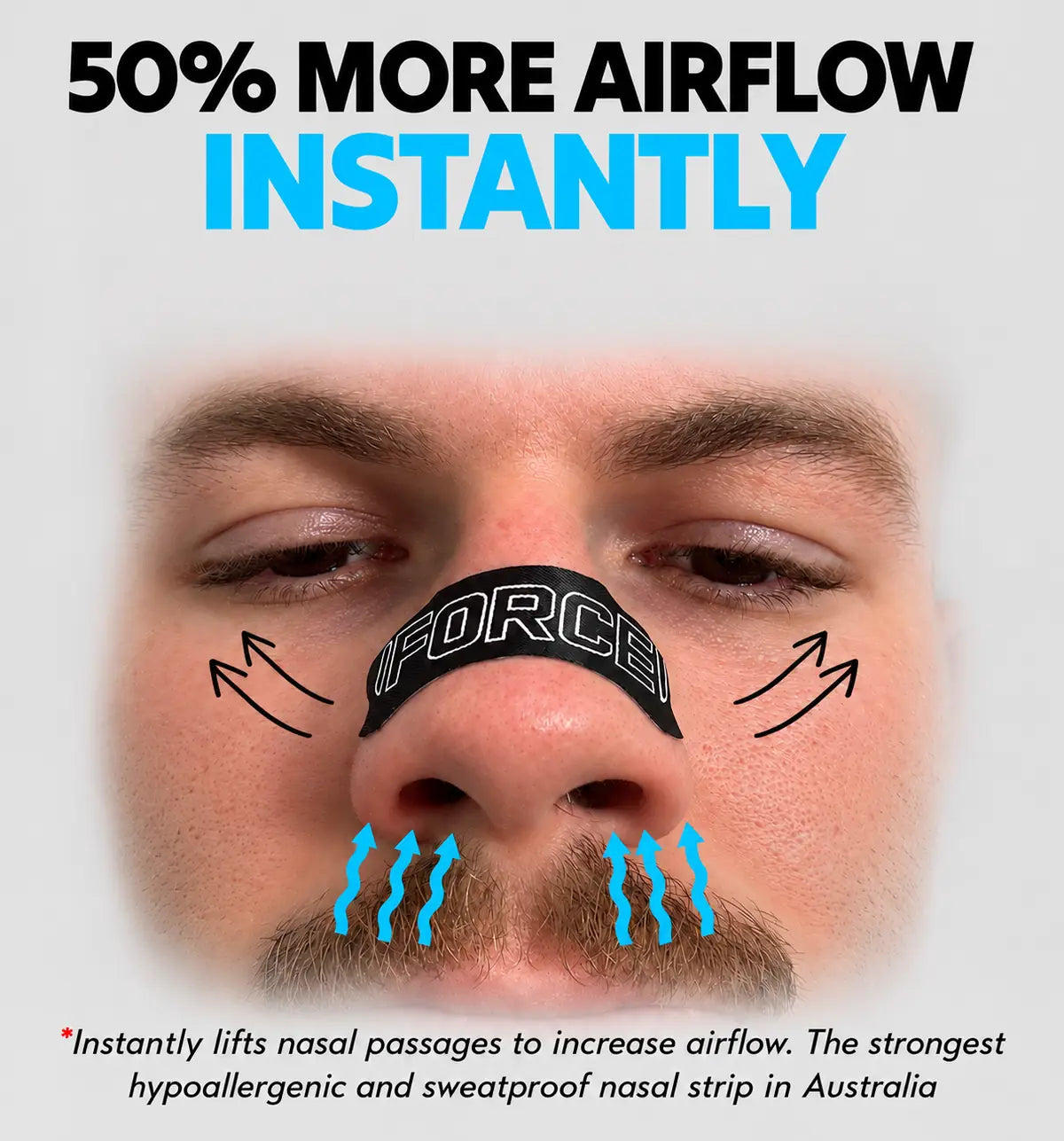
Nose tape is the everyday name for a nasal strip: a thin adhesive band across the bridge of the nose that holds the sides of the nose open. Inside the nose is a narrow gate called the internal nasal valve, and the strip lifts it from the outside so more air can move through. Here is how it works, what the studies found and how to choose one with Force Tape Airflow+.

Force Tape is an Australian breathwear brand: worn equipment for breathing, built for training and sleep. Its nose tape is Force Tape Airflow+, a strip made to stay on through sweat and effort.
What Nose Tape Is
Nose tape is a nasal strip. It is a thin, flexible band with an adhesive side that sticks across the bridge of the nose. You will also see it called nasal tape, a nose strip or, in the studies, an external nasal dilator (Kiyohara 2016).
People wear nose tape for breathing in training, in races and in bed. It sits on the outside of the nose. Mouth tape is a different product that goes over the lips, and our guide to nasal strips or mouth tape shows which to use first.
How Nose Tape Works
Each side of your nose has a narrow gate called the internal nasal valve. It is the narrowest part of the nasal airway (Kiyohara 2016), so it sets how easily air gets in.
The strip sticks to the skin on both sides of the bridge and tries to straighten. That gentle pull lifts the sides of the nose outward and holds the gate open, so more air can flow in, most of all as you breathe in (Sleep Foundation 2026). A nose specialist at Henry Ford Health describes it as a piece of tape across the bridge of the nose that opens up the nasal valve (Henry Ford Health 2026).
What the Studies Found
Researchers measure this with the strip on and off. In 27 healthy adults a nasal strip widened the narrowest point of the nasal valve and lowered nasal resistance (Peltonen 2004). In 47 volunteers it lowered resistance to airflow on the way in and on the way out (Wong 2004).
In a lab, 15 healthy adults pedalled a bike at up to 230 watts. The strip lowered nasal resistance in 11 of them, and for those 11 the effort of breathing through the nose went down while they pedalled (Gehring 2000).
Who Wears Nose Tape
The Sleep Foundation says nasal strips were first popularised by Olympic athletes (Sleep Foundation 2026). Today they are worn from the start line to the bedside, and our guides cover running, sleep and what athletes use.
★★★★★“I purchased these honestly being quite skeptical that it would do anything and nasal strips are a fad. I was wrong. I have broken my nose more times than I can count so am normally a mouth breather during exercise and sport. I decided I'd give these strips a go on a big event and was completely surprised when I could breathe easier through my nose.”
DawsonVerified buyer · Airflow+ Nasal Strips | Sport

Choosing the Best Nose Tape
Nose tapes differ in hold, colour and size, so choose by what you are doing. Force Tape Airflow+ comes in three.
- Hard sessions and race days. Black Sport is sports nose tape built to stay on through sweat.
- Easy days and sleep. Clear/Lite is built lighter for sensitive skin and is more discreet.
- A smaller nose. Mini is sized for it.
- Cost. One strip works out at $1.17 in a single pack and $0.58 on a 6-pack subscription.
Want every brand side by side? Our guide to the best nasal strips in Australia compares them.
Choose your strip
Black Sport, Clear/Lite or Mini, from $0.58 a strip on a 6-pack subscription.
Shop Airflow+How to Put Nose Tape On
- Clean and dry. Wash your nose and dry it fully, so the adhesive has clean skin to hold.
- Peel the backing. Hold the strip by its ends and peel the backing off.
- Centre it. Place it across the bridge of the nose, just above the nostrils, with both ends level.
- Press and rub. Press both ends down, then rub along the edges until the whole strip is stuck.
What Customers Say
“I am astounded at how these work.”
“Improvement was significantly noticeable in breathing immediately.”
“Didn’t know what to expect. Surprised in a good way.”
Try nose tape that stays on
Black Sport for hard sessions, Clear/Lite for easy days and sleep. Backed by our 30-day money-back guarantee.
Shop Airflow+ Shop allFrequently asked questions
What does nose tape do?
Nose tape holds the sides of the nose open, so more air moves through it as you breathe in. People wear it to train, to race and to sleep. Force Tape Airflow+ is nose tape made for all three: Black Sport for hard sessions and Clear/Lite for easy days and sleep.
Does nose tape work?
In studies on healthy adults, a nasal strip widened the nasal valve and lowered nasal resistance (Peltonen 2004; Wong 2004). A review of 33 over-the-counter dilators found five studies backing strips (Kiyohara 2016). Many people notice it straight away, and the reviews on this page are from verified buyers.
Is nose tape the same as a nasal strip?
Yes. Nose tape, nasal tape, nose strip and nasal strip all mean the same band across the bridge of the nose. The studies call it an external nasal dilator (Kiyohara 2016). Mouth tape is different: it goes over the lips, not the nose.
Where do you put nose tape?
Across the bridge of the nose, just above the nostrils, with both ends level. Clean and dry the skin, peel the backing, press the strip down and rub the edges. Every size and colour goes on the same way, and our how to apply guide has the steps.
What is the best nose tape for sleeping?
Force Tape Airflow+ Clear/Lite is built lighter for sensitive skin and is more discreet, so it suits sleep, and Mini is sized for a smaller nose. A verified buyer wrote “I use the nasal tape while sleeping” (Judge.me, 2026). Our sleep guide ranks the options.